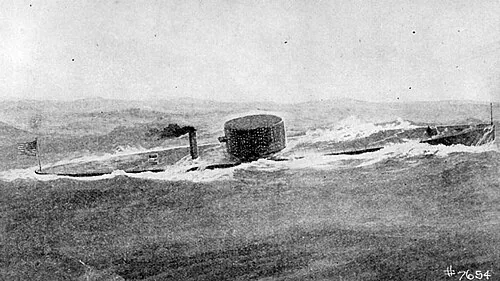
A ship built against the clock
USS Monitor was constructed at Continental Iron Works in Greenpoint, Brooklyn, after John Ericsson persuaded the Navy ironclad board to accept his unconventional design. The urgency was real: the Confederacy was preparing CSS Virginia, and Union planners feared that an armored ship could destroy wooden blockaders and threaten ports along the coast.
Monitor was launched on 30 January 1862 and commissioned on 25 February. Her low deck, cylindrical turret, armored pilot house, and absence of conventional masts gave her an appearance unlike traditional warships. Below that profile were compact machinery spaces, crew accommodations, magazines, pumps, ventilation systems, and the complicated mechanisms needed to rotate and operate the turret.
The ship was experimental in the literal sense. Officers and crew had to learn how to steer, communicate, ventilate, fight, and maintain a vessel for which there was little previous service experience. Design innovation and human adaptation were inseparable.
The passage to Hampton Roads
The voyage south exposed the limits of the low-freeboard hull. Water swept across the deck and threatened openings, while ventilation and machinery problems demanded constant attention. The crew brought the ship through severe conditions and reached Hampton Roads after CSS Virginia had already attacked the Union squadron.
That difficult passage is essential to understanding Monitor. A ship can be well protected against gunfire and still be vulnerable to weather, flooding, mechanical failure, and the demands placed on its crew. The same low silhouette that reduced the target in combat made the vessel hazardous in rough seas.
The battle with CSS Virginia
On 9 March 1862, Monitor engaged CSS Virginia at Hampton Roads. The two ironclads maneuvered at close range while their guns struck armor that resisted decisive penetration. Monitor used the rotating turret to fire across changing bearings, while Virginia relied on a broadside battery and a different armored form.
The action ended without either vessel being destroyed. Monitor prevented Virginia from continuing the attack against the remaining Union ships, and the blockade held. The engagement became a global symbol of the transition from wooden sailing battle fleets to armored steam warships.
Popular summaries often present the battle as a simple duel between old and new. In reality both ships were new, improvised, and imperfect. Turret operation, visibility, command, ammunition handling, maneuvering, and crew endurance all affected the fight. The historical importance lies as much in what the battle revealed as in the tactical result.
James River operations
Monitor remained in the Hampton Roads and James River area after the battle. She supported Union operations and stood ready for renewed Confederate naval action. Her work included the long periods of watch, maintenance, and coordination that rarely receive the attention given to a famous engagement.
Service also generated practical knowledge. Crew members and officers learned how the turret behaved, how the ship responded in confined waters, how heat and ventilation affected endurance, and how rapidly mechanical problems could become tactical problems. Later monitor construction drew on those lessons.
Foundering off Cape Hatteras
Late in December 1862, Monitor was ordered south under tow. Heavy seas off Cape Hatteras overwhelmed the low deck and forced water into the ship faster than pumps could control it. On 31 December she sank. Forty-six people survived; sixteen were lost.
The loss was not a contradiction of the ship combat performance. It revealed the boundaries of the design. Monitor was a specialized armored combatant whose form offered advantages in sheltered waters but too little margin in an Atlantic storm. That distinction influenced later monitor designs and remains central to any fair assessment of the ship.
Discovery, sanctuary, and conservation
Researchers located the wreck in 1973 and confirmed its identity in 1974. The ship lies upside down in deep water off North Carolina. In 1975 the site became the first national marine sanctuary in the United States, establishing a protected framework for research and preservation.
NOAA and partner organizations conducted expeditions that documented the wreck and recovered major artifacts. The turret was raised in 2002. The Mariners Museum and Park serves as the principal repository for thousands of artifacts, including large machinery and structural components undergoing long-term conservation.
Monitor therefore has three connected lives: experimental warship, protected archaeological site, and conservation project. Its story continues in laboratories, museum galleries, archival records, and underwater surveys. That continuing work is one reason the ship merits a full hero profile rather than a short battle summary.
Class relationship
This ship is recorded as a member of Monitor class. Shared design history belongs on the class page; this page concentrates on the individual hull where evidence is available.
Sources and further reading
- Monitor I (Ironclad Monitor) ↗Naval History and Heritage Command · accessed 2026-09-18
- USS Monitor (Ironclad) ↗Naval History and Heritage Command · accessed 2026-09-18
- History of the USS Monitor ↗NOAA Monitor National Marine Sanctuary · accessed 2026-10-03
- USS Monitor: shipwreck, discovery, and conservation ↗NOAA Monitor National Marine Sanctuary · accessed 2026-10-03
- USS Monitor conservation ↗The Mariners' Museum and Park · accessed 2026-10-03