Overview and identity
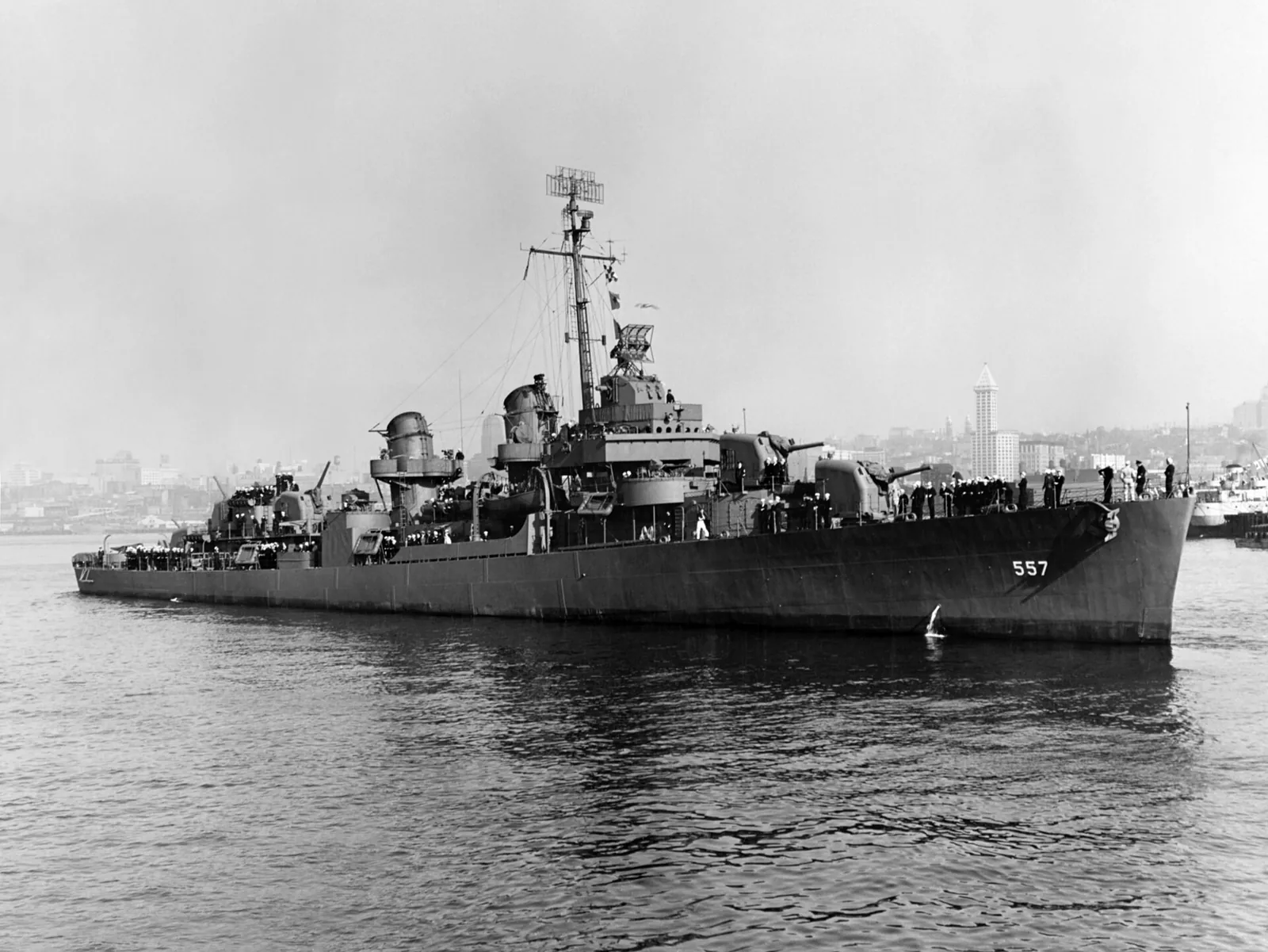
USS Johnston (DD-557) was a Fletcher-class destroyer commissioned in October 1943 under Commander Ernest E. Evans. In less than a year of service she took part in Pacific operations before her loss in one of the best-known destroyer actions of World War II.
USS Johnston can be distinguished by the hull or pennant designation DD-557, membership in Fletcher class, and service with United States Navy. Its history belongs to World War II and early Cold War and to the broader development of destroyers and torpedo combatants. Destroyers and torpedo combatants were built around speed, responsiveness, and the ability to screen larger ships or attack enemy forces. Their roles expanded over time to include anti-submarine warfare, air defense, surface attack, escort duty, and land attack, which makes configuration and era especially important.
Construction and class context
The sources reviewed do not provide a complete builder and construction chronology for USS Johnston. Construction dates help place the ship within its class program and distinguish the original build from later changes in name, classification, armament, or mission.
The Fletcher class was the U.S. Navy’s largest World War II destroyer class, with 175 ships completed. The design provided a robust combination of speed, five-inch gunfire, torpedo armament, anti-aircraft growth potential, and enough size to absorb wartime modifications. Fletchers were built in very large numbers as the Navy expanded for global war. The design proved adaptable to changing anti-aircraft and anti-submarine requirements, and many surviving ships continued in U.S. Or foreign service after 1945. The class history explains the common design; this article concentrates on the evidence specific to USS Johnston, including construction, assignments, modifications, transfers, and fate where documented.
Service history
After operations in the Marshalls and other Pacific campaigns, Johnston joined the escort-carrier force known as Taffy 3 off Samar. On 25 October 1944 Evans led aggressive attacks against a much heavier Japanese force. Johnston was overwhelmed and sunk after prolonged action; Evans later received the Medal of Honor. Johnston used the common Fletcher technical baseline; what makes her historical account distinct is not a separate class specification but the ship-specific sequence of combat, damage, and loss. Names and designations documented during the ship’s career include USS Johnston (1943-10-27 - 1944-10-25 · United States Navy).
As a member of Fletcher class, USS Johnston began with the design, machinery, protection, and mission assumptions shared by the class. Those assumptions included screening of larger fleet units, anti-surface warfare, anti-submarine warfare, and delivery of naval gunfire against targets ashore. Ship-specific refits, damage repair, transfers, reclassification, and changing assignments could alter that baseline. Class-level information is therefore used as context, not as proof that every feature remained aboard throughout this ship's career.
Technical configuration
The Fletcher-class World War II baseline configuration, dated 1943 - 1945, is presented as a class-level configuration used for context. Its listed characteristics include displacement 2,050 long ton (unknown), length 376.42 ft, beam 39.58 ft, and draft 13.75 ft. The recorded armament is 5 × 5-inch guns; 10 × 40 mm; 7 × 20 mm; 10 × 21-inch torpedo tubes; depth-charge projectors/tracks (The Sullivans fit). For USS Johnston, it should be read as shared class context rather than proof of a ship-specific fit on every date.
Later service and disposition
USS Johnston was sunk. The associated date is 1944-10-25. The recorded location is Battle off Samar. Lost in action.
The sources reviewed do not identify USS Johnston as preserved. Its history must therefore be reconstructed through documents, photographs, technical records, and evidence connected to the class and operating navy.
Historical significance
Johnston demonstrates why individual hull histories remain essential even in a class of 175 ships. Its value lies in connecting a specific vessel, its identities, and its known service outcome to the wider history of the class.
The evidence currently available for USS Johnston is strongest on its documented names and designations, its recorded service, and its final status. The article separates those ship-specific facts from the shared characteristics of Fletcher class, so readers can see both what is known about this vessel and where the historical record still needs stronger documentation.
Class relationship
This ship is recorded as a member of Fletcher class. Shared design history belongs on the class page; this page concentrates on the individual hull where evidence is available.
Sources and further reading
- USS Johnston (DD-557) ↗Naval History and Heritage Command · accessed 2026-09-18
- Johnston (DD-557) ↗Naval History and Heritage Command · accessed 2026-09-18