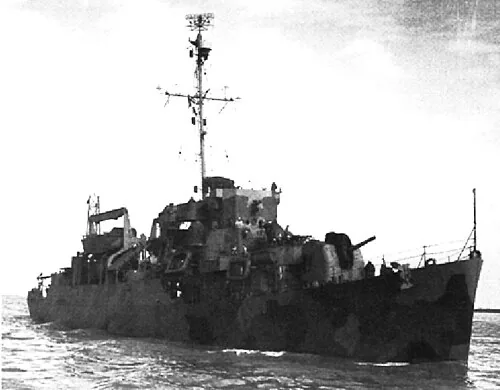
Overview and identity
USS Jack C. Robinson is documented as an ship in the Charles Lawrence-class high-speed-transport roster.
USS Jack C. Robinson is identified through hull or pennant designation APD-72, service with United States Navy, and membership in Charles Lawrence class. Its history belongs to the Second World War and to the wider development of amphibious warfare. These identity checks separate the vessel from other ships that may have carried the same or a similar name.
Construction and class context
USS Jack C. Robinson was built at a builder not identified in the reviewed record. The documented chronology records construction dates not yet confirmed in the reviewed record. These dates place the vessel within the construction sequence of Charles Lawrence class and provide fixed points for distinguishing original features from later alterations.
The Charles Lawrence class comprised Buckley-design destroyer-escort hulls converted or completed as high-speed transports for amphibious operations late in World War II. The Navy selected fifty Buckley-type hulls for the APD program. Thirty-seven were converted after destroyer-escort service and six were completed directly as APDs; seven planned conversions were not completed. The documented service history connects each converted DE as the same ship across both class memberships. This class-level history explains the common requirement and design; the present article remains focused on evidence that can be attached specifically to USS Jack C. Robinson.
Service history
The reviewed ship record does not yet provide a detailed operational chronology for USS Jack C. Robinson. The page therefore preserves the confirmed construction, identity, class, and disposition evidence without assigning the ship operations documented only for another member of the class.
The operating context of Charles Lawrence class included troop transport, amphibious support, and underwater demolition team support. That context explains why the ship was built, but it is not treated as proof that USS Jack C. Robinson participated in an undocumented deployment or action. Ship-specific operations require dated orders, logs, official histories, or equivalent evidence.
Configuration and change
As a member of Charles Lawrence class, USS Jack C. Robinson shared a design baseline associated with high-speed transport and features such as high speed transport, destroyer escort conversion, buckley design, and world war ii. The baseline is useful for understanding the vessel’s intended capabilities, but it does not establish that every weapon, sensor, boat, aircraft, or machinery arrangement remained aboard throughout the ship’s career.
Any dated configuration for USS Jack C. Robinson must distinguish original construction from later refits, wartime additions, repair work, transfers, and changes in mission. Where the reviewed evidence provides only class-level data, this profile presents it as context and avoids converting it into a permanent ship-specific specification.
Later service and disposition
The later service and final disposition of USS Jack C. Robinson have not been confirmed in the sources reviewed.
No preservation status is established for USS Jack C. Robinson in the reviewed record. Reserve service, transfer, renaming, disposal, loss, or museum preservation should be added only when a subject-specific source establishes it.
Historical significance and evidence
USS Jack C. Robinson provides an individual case within the history of Charles Lawrence class. Its value lies in connecting one documented hull, construction chronology, service identity, and outcome to the broader design and operational history of the class.
The class demonstrates how the mass-produced destroyer-escort hull could be repurposed into a fast amphibious transport without treating conversion as a new ship. For USS Jack C. Robinson, historical significance should remain ship-specific: the article must show what this vessel did, how it changed, and how its career differed from other members of Charles Lawrence class, rather than repeating the class article as if every ship shared one service history.
The evidence used for USS Jack C. Robinson includes Destroyer History Foundation, Destroyer escort-transports (APD) in World War II, Destroyer History Foundation, Buckley-class destroyer escorts in World War II, and NavSource Naval History, High-speed Transport (APD) / Amphibious Transport, Small (LPR) Photo Index. These sources support the chronology and identification presented here; where they do not establish a ship-specific event or configuration, the profile says so rather than borrowing details from another vessel.
Class relationship
This ship is recorded as a member of Charles Lawrence class. Shared design history belongs on the class page; this page concentrates on the individual hull where evidence is available.
Sources and further reading
- Destroyer escort-transports (APD) in World War II ↗Destroyer History Foundation · accessed 2026-09-19
- Buckley-class destroyer escorts in World War II ↗Destroyer History Foundation · accessed 2026-09-19
- High-speed Transport (APD) / Amphibious Transport, Small (LPR) Photo Index ↗NavSource Naval History · accessed 2026-09-19
- Charles Lawrence (DE-53) ↗Naval History and Heritage Command · accessed 2026-09-19