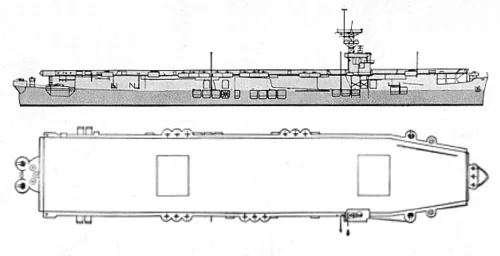
Overview and historical setting
The Sangamon class converted four large fleet oilers into escort carriers during 1942.
Sangamon class belongs to the history of naval aviation ships. The class was developed for United States Navy during the Second World War, and contemporary descriptions identify it as escort aircraft carrier. This setting matters because the design should be read against the missions, technology, and fleet organization available to that navy at the time.
Development and program
Their tanker origins produced larger, faster, and more damage-tolerant ships than many cargo-ship conversions, while preserving long endurance and useful aviation capacity.
For Sangamon class, the documented program can be summarized as construction activity is recorded from 1938 to 1942, 4 planned, 4 ordered, 4 completed, and 0 cancelled. Those figures separate the intended program from the ships that actually reached completion, a distinction that is especially important when requirements changed during a long construction cycle.
The recorded lineage links Sangamon class to no explicitly identified predecessor. Lineage is treated as evidence of design relationship, not proof that equipment, protection, or operating doctrine remained unchanged from one class to the next.
Design and operational role
The technical character of Sangamon class is described through escort carrier, tanker conversion, and steam-turbine propulsion. These characteristics are most useful when connected to the missions assigned to the class, including escort air operations, antisubmarine warfare, and amphibious support; they explain what the navy expected the ships to do rather than serving as an isolated list of specifications.
Sangamon class should not be treated as one permanently fixed configuration. Individual members could differ during construction and later change through refits, revised weapons, new sensors, altered boats or aircraft, and changes in crew or command facilities. The class page establishes the shared baseline, while dated ship evidence is needed for any claim about a particular hull.
Ships of the class
The documented roster for Sangamon class contains 4 ships, and the roster is marked complete. The named members are USS Sangamon, USS Suwanee, USS Chenango, and USS Santee.
The roster gives Sangamon class a measurable production history rather than treating the class as an abstract design. Comparing the member pages can reveal construction differences, refits, transfers, renamings, losses, and preservation outcomes that a class-wide summary cannot assign safely to every ship.
Across the member records, the currently documented outcomes are 4 not confirmed. This summary reflects the available ship records and should be revised when stronger evidence changes an individual vessel’s status.
Service history
All four served in major amphibious and carrier-support operations from North Africa through the Pacific.
Service within Sangamon class was not necessarily uniform. Ships built to the same design could enter different theaters, receive different modernizations, or leave service under different conditions. For that reason, an operation documented for one member is not presented as a class-wide experience unless the supporting source makes that connection.
Historical significance and evidence
The class demonstrated the value of large tanker hulls for escort aviation and helped shape the later purpose-built Commencement Bay design.
The significance of Sangamon class is best evaluated by comparing its intended roles, the design features selected to meet them, the number of ships actually completed, and the different outcomes recorded across the class. That approach turns the program and roster into evidence about naval priorities rather than treating the class only as a set of measurements.
The evidence used for Sangamon class includes Navypedia, SANGAMON escort aircraft carriers (1942). These sources support the chronology and identification presented here; where they do not establish a ship-specific event or configuration, the profile says so rather than borrowing details from another vessel.
For Sangamon class, the evidentiary core is strengthened by reading the program, roster, and design information together. The current structured summary includes Type: Escort aircraft carrier; Ships completed: 4; Ships planned: 4. Those details provide a concrete basis for comparing the class with its contemporaries while keeping later refits and individual ship careers separate from the shared design baseline.
Ships in this class
Showing 4 recorded class members.
Sources and further reading
- SANGAMON escort aircraft carriers (1942) ↗Navypedia · accessed 2026-09-18