Requirement and Standard-type lineage
The Pennsylvania class followed the Nevada class in the sequence of American battleships commonly described as the Standard types. The concept sought ships with compatible speed, tactical radius, and turning characteristics so that different classes could fight together as one battle line. Pennsylvania and Arizona retained the oil-fired machinery and concentrated protection associated with the new system, but they increased the main battery from ten to twelve 14-inch guns.
The extra pair of guns did not require a fifth turret. Four triple mountings placed two turrets forward and two aft, giving the class a powerful broadside while avoiding the weight and internal complexity of an additional barbette and magazine. This arrangement became one of the class defining features and distinguished the ships from the mixed twin and triple turret layout of Nevada and Oklahoma.
The design emerged during a period when the United States expected battleships to meet enemy capital ships in a deliberate fleet action. Range, underwater protection, magazine security, fire control, and the ability to absorb damage mattered as much as headline gun caliber. The class therefore represents a system of choices rather than a single large weapon mounted on a hull.
Design, protection, and firepower
As completed, the ships displaced about 31,400 long tons at normal load and measured roughly 608 feet in length. Their twelve 14-inch guns formed the central striking power of the design, while a battery of 5-inch guns was intended to deal with destroyers and other lighter threats. A top speed of about 21 knots matched the tactical assumptions of the Standard-type battle line, but it also placed the class below the speed later expected of carrier escorts and fast battleships.
Protection followed the all-or-nothing principle: the most important spaces received heavy armor, while less critical sections were not given a thinner compromise belt. The purpose was to preserve magazines, machinery, command spaces, and flotation against heavy shellfire at anticipated battle ranges. The system was closely tied to the internal subdivision and underwater defense scheme, so its effectiveness cannot be reduced to one belt thickness.
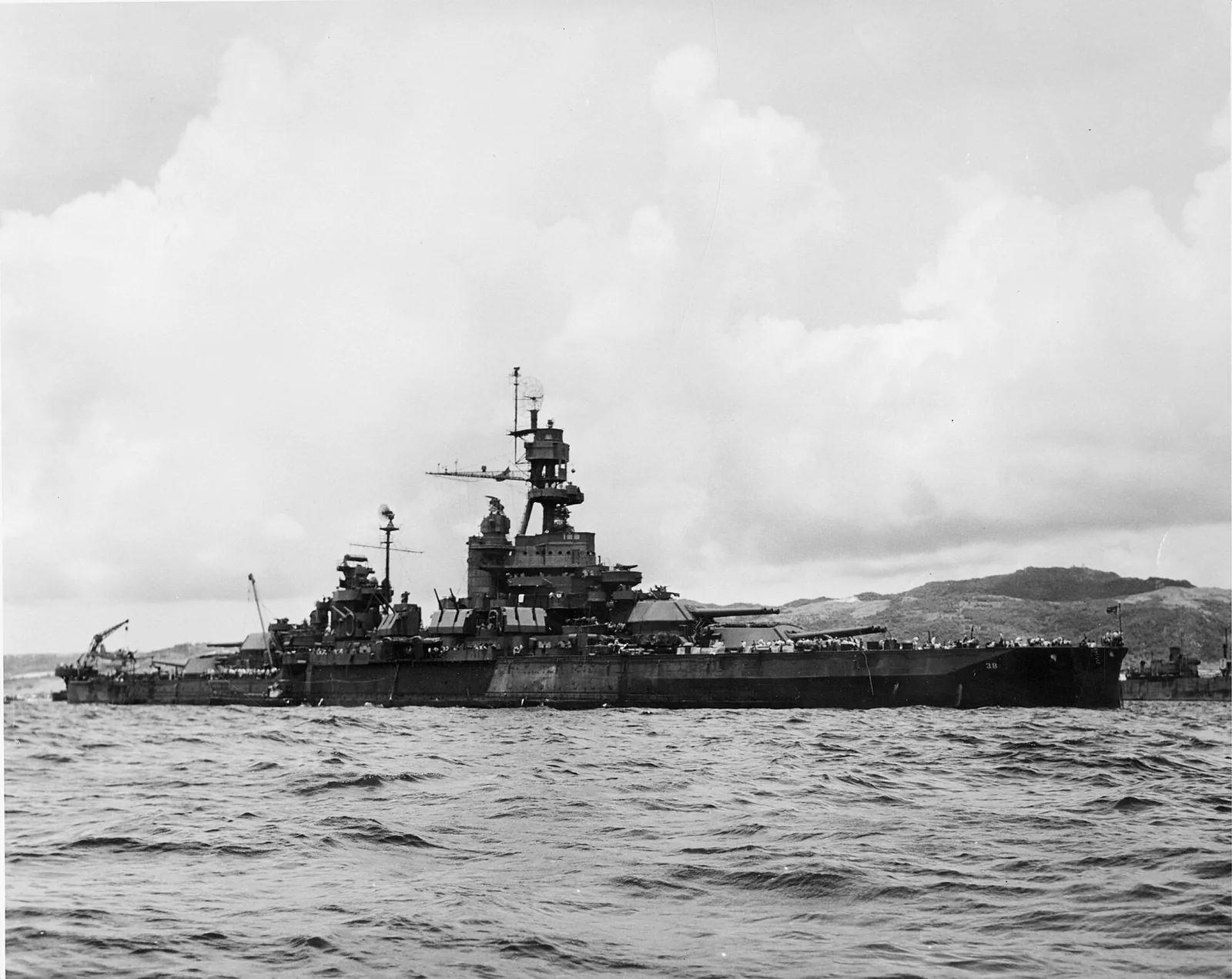
The class also illustrates the gap between an as-built specification and a ship over a long career. Anti-aircraft weapons, fire-control equipment, secondary batteries, masts, superstructure, deck protection, and underwater defenses all changed. A photograph from the 1930s does not show the same fighting system that entered service in 1916, even though the hull and main battery remained recognizable.
Interwar reconstruction
Both ships spent much of the interwar period in the battle fleet and underwent major modernization. Reconstruction replaced the original cage-mast appearance with heavier tripod arrangements, altered machinery and protection, improved fire control, and strengthened defenses against aircraft. These changes reflected lessons from wartime gunnery, the growing reach of naval aviation, and the need to keep older capital ships useful as technology advanced.
Modernization improved capability but could not remove every limitation of the original design. The ships remained 21-knot battleships, and wartime additions increased topweight and crew demands. Their later value depended on missions that made use of heavy guns, protection, command capacity, and endurance rather than on keeping pace with the fastest carrier forces.
Service of Pennsylvania and Arizona
Pennsylvania and Arizona commissioned in 1916. During the First World War, oil availability and operational priorities kept them in American waters rather than sending them with the coal-fired battleships that joined the British Grand Fleet. Their wartime work centered on readiness, training, and Atlantic Fleet operations, followed by the peacetime cycle of exercises, fleet problems, and modernization.
The two ships shared a class history but not identical careers. Pennsylvania became a fleet flagship and later delivered extensive shore bombardment in the Pacific. Arizona became one of the most recognizable symbols of the attack on Pearl Harbor. A useful class page therefore establishes the common design and program, while the individual pages explain how the two hulls diverged in operations, damage, survival, and memory.
That divergence also warns against treating class specifications as permanent ship-specific facts. Pennsylvania received wartime repairs, additional anti-aircraft weapons, and operational changes after the attack. Arizona did not receive the same wartime evolution. The correct question is not only what the class was designed to be, but what each ship had become at a specific date.
Diverging wartime fates
Arizona was destroyed at Pearl Harbor on 7 December 1941 after a bomb penetrated near the forward magazines and the resulting explosion devastated the ship. Pennsylvania, in dry dock during the attack, survived and returned to service. She supported campaigns across the Pacific and was later used in the postwar atomic-bomb tests at Bikini before being scuttled in 1948.
The class therefore links several major chapters in twentieth-century naval history: the mature dreadnought battle line, interwar modernization, the shock of Pearl Harbor, amphibious warfare in the Pacific, the arrival of the atomic age, and the transformation of a wreck into a national memorial. Few two-ship classes produced such sharply different endings.
Historical significance
The Pennsylvania class marked an important step in the development of the American Standard-type battleship. It combined a uniform twelve-gun main battery with oil firing, concentrated protection, and battle-line handling characteristics intended to work with neighboring classes. Its importance lies in how those design decisions served the Navy across changing strategic eras.
The surviving evidence also gives the class unusual public meaning. Pennsylvania represents the older battleship adapted for a demanding Pacific war. Arizona remains both a wreck and a place of remembrance. Reading the class and ship pages together makes clear why design history, operational history, and memorial history belong in the same archive but should not be collapsed into the same narrative.
Ships in this class
Showing 2 recorded class members.
Sources and further reading
- Conway's All the World's Fighting Ships, 1906–1921Conway Maritime Press
- Pennsylvania III (Battleship No. 38) ↗Naval History and Heritage Command · accessed 2026-09-18
- Arizona II (Battleship No. 39) ↗Naval History and Heritage Command · accessed 2026-09-18
- USS Arizona ↗National Park Service, Pearl Harbor National Memorial · accessed 2026-10-03