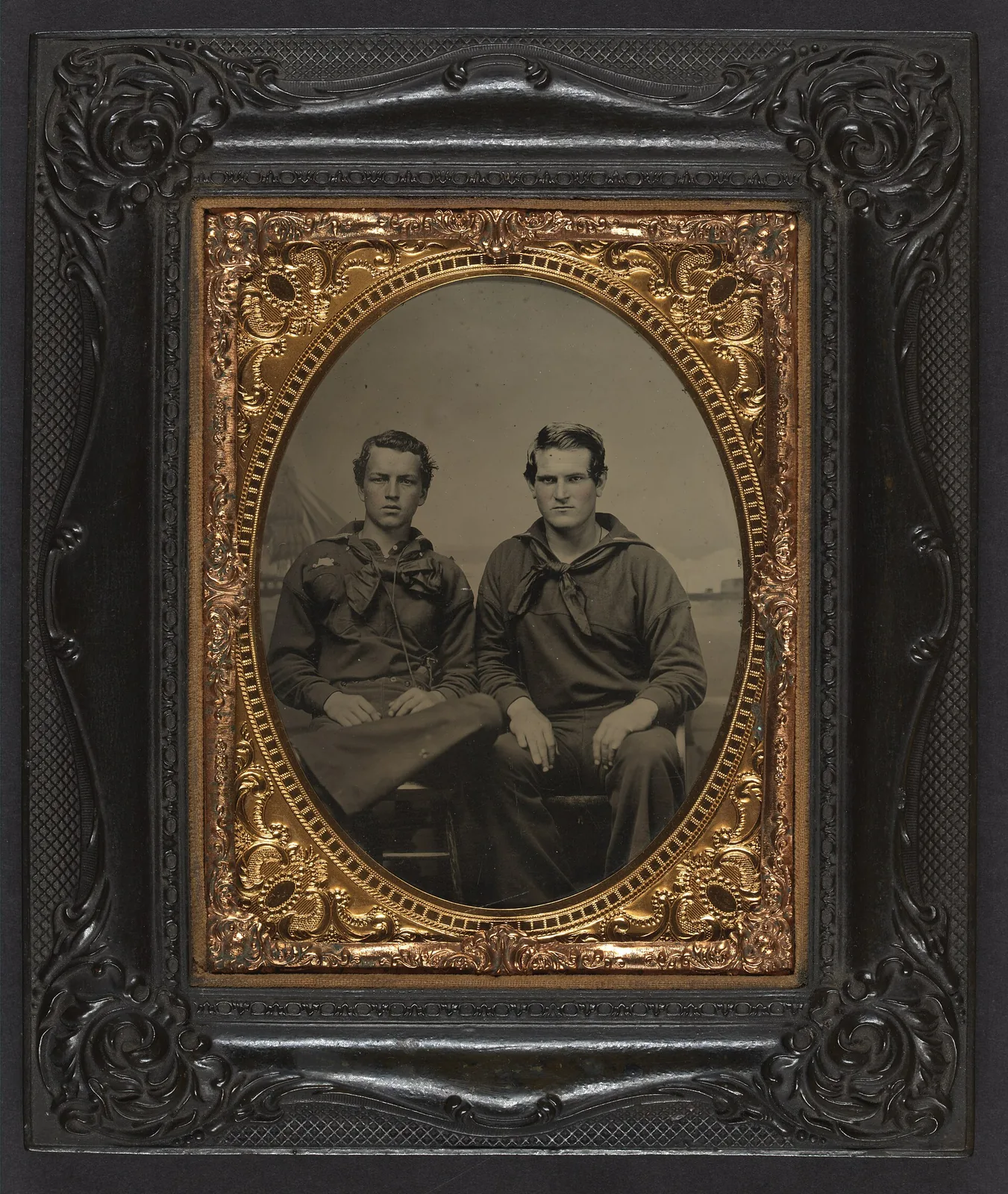
An emergency design for an emergency war
The Monitor design emerged during the American Civil War as the Union confronted reports that the Confederacy was converting the steam frigate Merrimack into the armored warship CSS Virginia. A naval board considered several ironclad proposals, and John Ericsson offered a compact vessel whose most striking features were a very low armored deck and a steam-powered rotating gun turret.
Speed of construction mattered. The Navy was not commissioning a mature design developed through years of trials. It was accepting technical risk in response to an immediate threat. Monitor was built at Continental Iron Works in Greenpoint, Brooklyn, launched on 30 January 1862, and commissioned less than a month later.
The class consisted of one ship, but its influence was much larger than its size. The name Monitor became a generic description for later low-freeboard turret ships built for coastal defense, river operations, and bombardment. Those later vessels were not identical copies. They were responses to the possibilities and shortcomings revealed by the original.
Hull, turret, and fighting concept
Monitor displaced about 987 tons and measured roughly 173 feet long with a beam of 41 feet 6 inches. Two 11-inch Dahlgren smoothbores were housed in a single rotating turret. The turret allowed the guns to train without turning the entire ship, a sharp break from the broadside arrangement that still dominated warship design.
The low freeboard presented a small target and allowed armor to be concentrated, but it created serious seakeeping and habitability problems. The deck sat close to the water, ventilation was limited, visibility from enclosed positions was poor, and openings had to be carefully managed. The design was suited to sheltered waters more than to rough ocean passages.
Monitor should not be described as the inevitable future arriving fully formed. Her turret was revolutionary, but the ship also exposed the difficulty of combining armor, machinery, stability, living conditions, and seaworthiness in a compact hull. Later monitor designs changed freeboard, turret count, hull form, and internal arrangements because the original was both an inspiration and a warning.
Hampton Roads and the limits of a single battle
Monitor reached Hampton Roads after CSS Virginia had attacked wooden Union warships. On 9 March 1862 the two ironclads fought for hours. Neither destroyed the other, but the engagement demonstrated that armored steam warships could survive fire that would have devastated wooden ships and that a rotating turret could deliver heavy guns across changing bearings.
The battle became the best-known event in the ship history, but it should not be allowed to simplify the design assessment. Monitor experienced difficulties with visibility, signaling, gun operation, and command. Virginia had different limitations. Their duel was an encounter between experimental systems rather than a clean test that produced one technical winner.
The strategic effect was still profound. Virginia did not break the Union blockade, and navies around the world paid close attention to the encounter. The battle accelerated interest in armor and turrets while reinforcing the conclusion that wooden battle fleets faced a rapidly changing technological environment.
James River service and loss at sea
After Hampton Roads, Monitor supported operations on the James River and remained available against further Confederate naval threats. The work was less famous but more representative of daily service: station keeping, readiness, maintenance, and cooperation with larger campaigns.
On 31 December 1862, the ship foundered in a storm while under tow off Cape Hatteras. Sixteen of the 62 people aboard were lost. The sinking confirmed the danger inherent in the low-freeboard design when exposed to heavy seas, even though the same form had offered advantages in protected combat waters.
Design legacy and preservation
Monitor gave its name to a broad warship category. American monitors evolved into larger coastal and riverine vessels, sometimes with multiple turrets and improved accommodation. Other navies explored turret ships through different design paths. The original ship therefore belongs both to Civil War history and to the international development of armored warships.
The wreck was located in 1973 and confirmed in 1974. In 1975 it became the first site designated as a United States national marine sanctuary. NOAA and its partners have documented the wreck and recovered major components, including the turret, while The Mariners Museum conserves more than 200 tons of artifacts.
That conservation work adds a second technical history to the class. Engineers and conservators must understand corrosion, materials, structure, and the long interaction between iron, salt water, sediment, and recovered artifacts. The surviving components allow the Monitor story to be studied at a level that written specifications alone cannot provide.
Ships in this class
Showing 1 recorded class members.
Sources and further reading
- Monitor I (Ironclad Monitor) ↗Naval History and Heritage Command · accessed 2026-09-18
- USS Monitor (Ironclad) ↗Naval History and Heritage Command · accessed 2026-09-18
- History of the USS Monitor ↗NOAA Monitor National Marine Sanctuary · accessed 2026-10-03
- USS Monitor: shipwreck, discovery, and conservation ↗NOAA Monitor National Marine Sanctuary · accessed 2026-10-03
- USS Monitor conservation ↗The Mariners' Museum and Park · accessed 2026-10-03