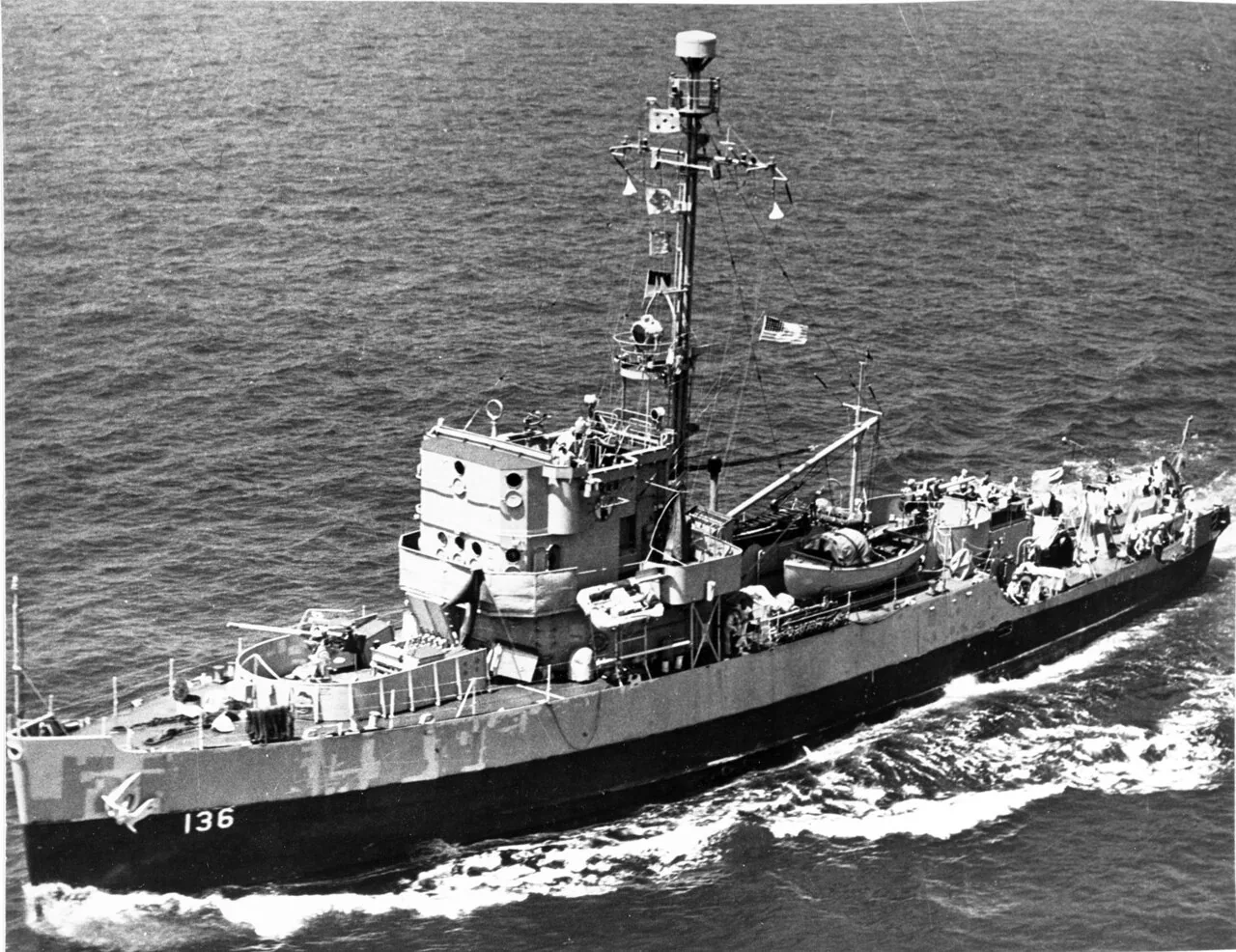
Overview and historical setting
The Admirable class was the U.S. Navy’s compact 184 ft 6 in wartime ocean/fleet minesweeper design.
The class belongs to the history of mine-warfare vessels and served during World War II and Cold War. Mine-warfare vessels operate in an environment where precision, low signatures, careful navigation, and specialized equipment matter more than heavy armament. Minesweeping and mine-countermeasures work can open ports, channels, and approach routes, making relatively small ships strategically important to the movement of an entire fleet. For Admirable class, the documented mission set included minesweeping, convoy escort, anti-submarine patrol, and postwar allied service.
Development and design
The design used the same basic hull form as the PCE-821 convoy-escort family but was fitted for mine countermeasures. U.S. Naval Institute procurement history records 174 Admirable hull-number orders and states that 125 were completed for the Navy, one as YDG-11. The detailed construction roster identifies 123 completed Admirable-program ships, including AM-359 completed as YDG-11. Published totals differ, and cancelled AM allocations are not counted as completed ships. The program chronology records design work beginning in 1942, construction beginning in 1942, and the documented construction period ending in 1946. Program totals list 174 planned, 174 ordered, and 123 completed. These dates and totals distinguish the design program from the number of ships that were actually completed and entered service.
The design evidence for Admirable class identifies diesel propulsion, mechanical minesweeping, and acoustic minesweeping and minesweeping, convoy escort, anti-submarine patrol, and postwar allied service. These features connect the class's technical arrangement to the work it was expected to perform for United States Navy. Later refits, revised sensors, new weapons, and changes in doctrine could alter the practical capabilities of individual members without changing their class identity.
Technical character
The Admirable class, standard wartime fleet-minesweeper configuration, dated from 1943, is presented as the as-completed configuration. Its listed characteristics include displacement 530 long ton (standard), displacement 945 long ton (full load), length 56.24 m, beam 10.06 m, and draft 2.97 m. The recorded armament is One 3-inch/50 gun with wartime antiaircraft and minesweeping fit varying by hull and delivery period. The figures describe one documented state and may not apply unchanged throughout the subject's service life.
The Drake / YDG-11 / Ampere, degaussing-tender conversion configuration, dated from 1945, is presented as conversion. The figures describe one documented state and may not apply unchanged throughout the subject's service life.
Technical data for Admirable class is most useful when tied to a date and mission. Displacement changed with fuel, ammunition, electronics, weapons, and later modifications; speed and range depended on operating conditions; and sensors or armament could vary substantially between members and periods of service.
Ships of the class
The documented roster contains 9 members. These include USS Admirable (AM-136, T-331), USS Counsel (AM-165, MSF-165), USS Crag (AM-214, DM-15, MSF-214), USS Hazard (AM-240, MSF-240), USS Marvel (AM-262, T-274), USS Rampart (AM-282, T-282), USS Superior (AM-311, MSF-311), Drake (ADG-11, AM-359, YDG-11), and USS Harlequin (AM-365, DM-20, MSF-365). The available sources support this as the complete class roster.
Individual ship histories are needed to show how a common design diverged through construction differences, refits, damage, transfers, new assignments, and final disposition. For a ship-level view of the class in service, see USS Hazard, whose profile follows the evidence available for one member of Admirable class.
Service history
The class served in World War II and the early Cold War. Thirty-four hulls entered Soviet service, including 24 Project Hula transfers in 1945; 21 later entered Mexican service. Additional ships served China/Taiwan, the Philippines, South Vietnam, South Korea, the Dominican Republic, and Burma. Numerous surviving U.S. Ships were reclassified MSF in 1955. USS Hazard survives at Freedom Park in Omaha. The shared design created a common starting point, while individual ships could accumulate different deployments, combat damage, modernization work, transfers, and end states.
Historical significance
Admirable-class ships carried a wartime minesweeper design into decades of allied service. The transfer history is especially important because a single ship could pass through several navies, names, pennants, and classifications over its career. Its documented design relationships identify related designs Auk class. Its significance is best assessed through the relationship between mission, technical choices, production scale, and the service experience of its members.
For Admirable class, the most useful points of comparison are the requirement for minesweeping, convoy escort, anti-submarine patrol, and postwar allied service, the use of diesel propulsion, mechanical minesweeping, and acoustic minesweeping, and a program recorded as 174 planned, 174 ordered, and 123 completed. Those factors help explain what the class offered United States Navy, how it differed from predecessors or contemporaries, and why ships built to the same design could still have different careers.
Understanding Admirable class across time requires separating the design as approved, the configuration in which individual ships entered service, and later changes made after operational experience. For United States Navy, that distinction matters because a refit could alter weapons, sensors, aviation facilities, command arrangements, or mission without creating a new class. The class history defines the common baseline; dated ship histories show how each member changed within it.
Ships in this class
Showing 123 recorded class members.
- Drake
- USS Admirable
- USS Adopt
- USS Advocate
- USS Agent
- USS Alarm
- USS Alchemy
- USS Apex
- USS Arcade
- USS Arch
- USS Armada
- USS Aspire
- USS Assail
- USS Astute
- USS Augury
- USS Barrier
- USS Bombard
- USS Bond
- USS Buoyant
- USS Candid
- USS Capable
- USS Captivate
- USS Caravan
- USS Caution
- USS Change
- USS Clamour
- USS Climax
- USS Compel
- USS Concise
- USS Control
- USS Counsel
- USS Crag
- USS Creddock
- USS Cruise
- USS Deft
- USS Delegate
- USS Density
- USS Design
- USS Device
- USS Diploma
- USS Dipper
- USS Disdain
- USS Dour
- USS Dunlin
- USS Eager
- USS Elusive
- USS Embattle
- USS Execute
- USS Facility
- USS Fancy
- USS Fixity
- USS Gadwall
- USS Garland
- USS Gavia
- USS Gayety
- USS Graylag
- USS Harlequin
- USS Harrier
- USS Hazard
- USS Hilarity
- USS Implicit
- USS Improve
- USS Inaugural
- USS Incessant
- USS Incredible
- USS Indicative
- USS Inflict
- USS Instill
- USS Intrigue
- USS Invade
- USS Jubilant
- USS Knave
- USS Lance
- USS Logic
- USS Lucid
- USS Magnet
- USS Mainstay
- USS Marvel
- USS Measure
- USS Method
- USS Mirth
- USS Nimble
- USS Notable
- USS Nucleus
- USS Opponent
- USS Palisade
- USS Penetrate
- USS Peril
- USS Phantom
- USS Pinnacle
- USS Pirate
- USS Pivot
- USS Pledge
- USS Prime
- USS Project
- USS Prowess
- USS Quest
- USS Rampart
- USS Ransom
- USS Rebel
- USS Recruit
- USS Reform
- USS Refresh
- USS Reign
- USS Report
- USS Salute
- USS Saunter
- USS Scout
- USS Scrimmage
- USS Scuffle
- USS Sentry
- USS Serene
- USS Shelter
- USS Signet
- USS Skirmish
- USS Skurry
- USS Spectacle
- USS Specter
- USS Staunch
- USS Strategy
- USS Strength
- USS Success
- USS Superior
Sources and further reading
- Ocean Minesweepers (AM) Built or Acquired through WWII ↗ShipbuildingHistory.com · accessed 2026-09-19
- Admirable (MSF-136) — NavSource Mine Warfare Vessel Photo Archive ↗NavSource Naval History · accessed 2026-09-19
- Crag (AM-214) — Dictionary of American Naval Fighting Ships ↗Naval History and Heritage Command · accessed 2026-09-19
- Historic Fleets — Admirable-class minesweepers ↗U.S. Naval Institute · accessed 2026-09-19
- Project HULA: Secret Soviet-American Naval Cooperation in the War Against JapanNaval Historical Center · accessed 2026-09-19
- Nebraska's National Historic Landmarks — USS Hazard ↗Nebraska State Historical Society · accessed 2026-09-19